
If Day 1 was the test — 39 kilometres of determination before your body had any idea what was coming — then Day 2 is the reward. Twenty-five kilometres, almost perfectly flat, following the Atlantic coast through a string of fishing villages that grow quieter and more Portuguese the further north you go. Your legs have found their rhythm. Your boots know your feet. You leave Póvoa de Varzim in the morning light and arrive in Esposende feeling like a pilgrim rather than a person who recently made a questionable decision.
The stage is one of the most purely coastal on the entire route. For most of those 25 kilometres you are within sight or sound of the ocean.
Leaving Póvoa de Varzim
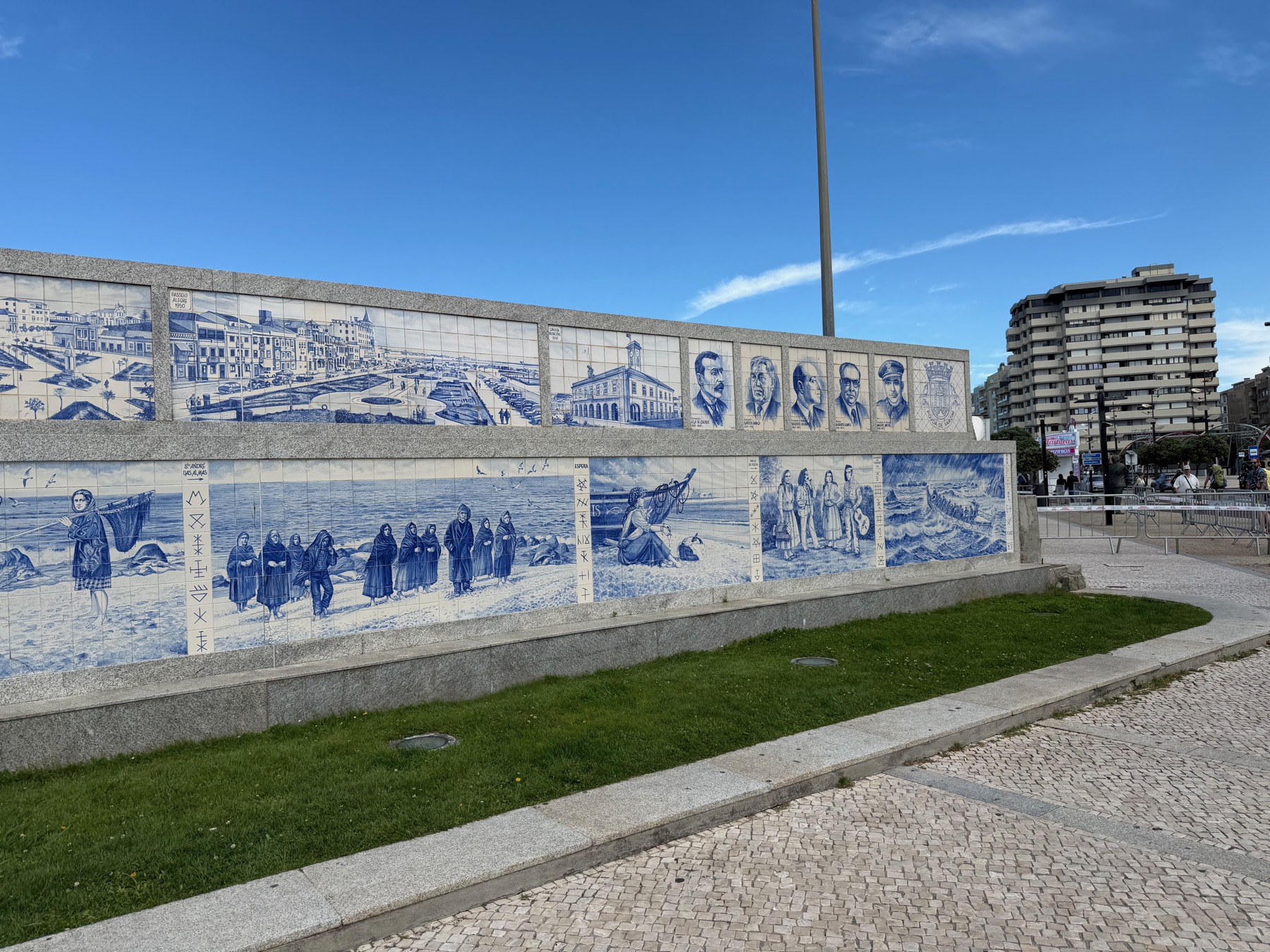
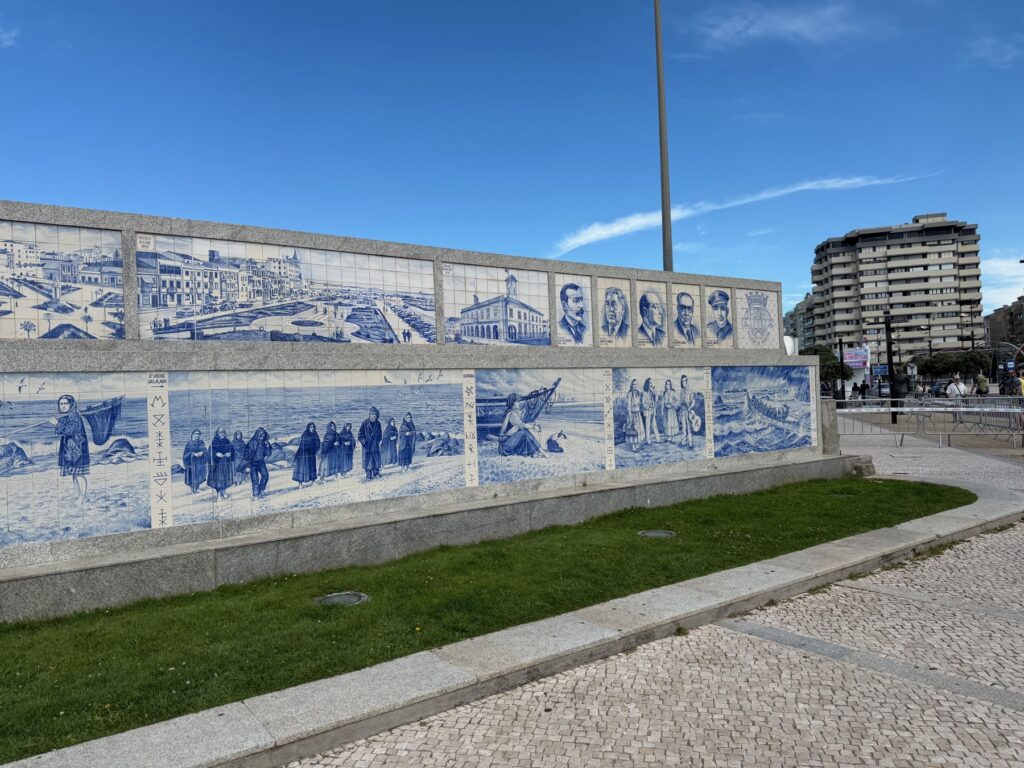
The yellow arrows lead you out along the seafront promenade, past one of the most striking public artworks on the entire Camino. The azulejo panel that runs along the Póvoa waterfront is a long sweep of blue and white tile depicting the city’s fishing history — women on the shore watching for boats, men working nets, old photographs of what the harbour looked like a century ago. It is the kind of thing you would normally walk past in two minutes; on the Camino, where your pace is different and your attention is freer, you find yourself stopping to read the details.
Póvoa de Varzim is a real city, not a tourist construct. The fishing industry still operates here; the market still sells the catch. Walking through in the early morning, you pass cafés full of people on their way to work, not pilgrims. The transition from city to coast happens gradually, and then all at once.
Aguçadoura
By around the 7 or 8 kilometre mark, the suburbs of Póvoa have dissolved and you are in Aguçadoura. This is the first of the small beach villages that mark the rhythm of Day 2 — places that exist at a different pace from the city, built around the sea and shaped by it.
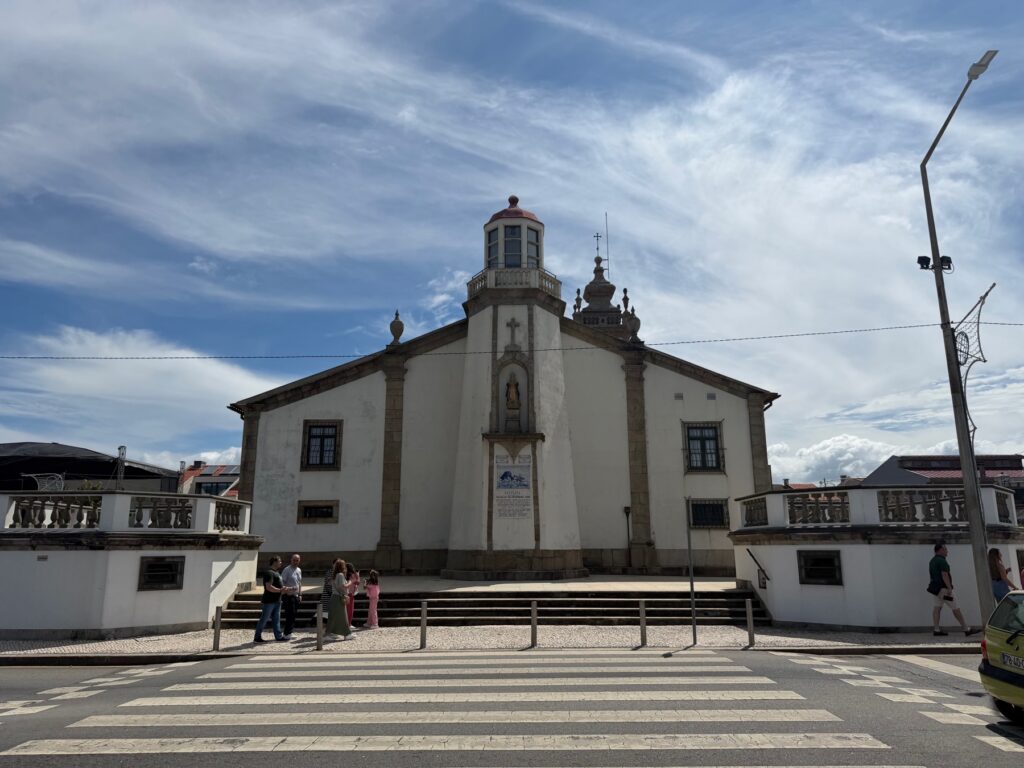
Standing near the village centre is a baroque chapel that stops you in your tracks. White-rendered walls, an ornate stone doorway, a shallow flight of steps, and that distinctive Portuguese octagonal lantern sitting on top like a lighthouse that forgot its purpose. These chapels appear throughout the coastal Camino, built by fishing families over centuries as places to pray before the boats went out. Some are locked; some are open and cool inside. This one is simply beautiful.
After Aguçadoura, the route stays close to the shore. The path is a mix of promenade, boardwalk, and firm beach sand. The Atlantic is always present — sometimes visible, sometimes just audible behind a dune — and the wind comes off it steady and cool regardless of what the sun is doing overhead.
Apúlia
Apúlia is famous for something you do not see anywhere else in Portugal: the fishing boats are kept on the beach itself, pulled above the tideline and stacked alongside their nets. No harbour, no marina — just colourful wooden hulls on the sand, the same as they have been for centuries. It is a working culture that has somehow outlasted modernisation, and worth stopping to look at properly.
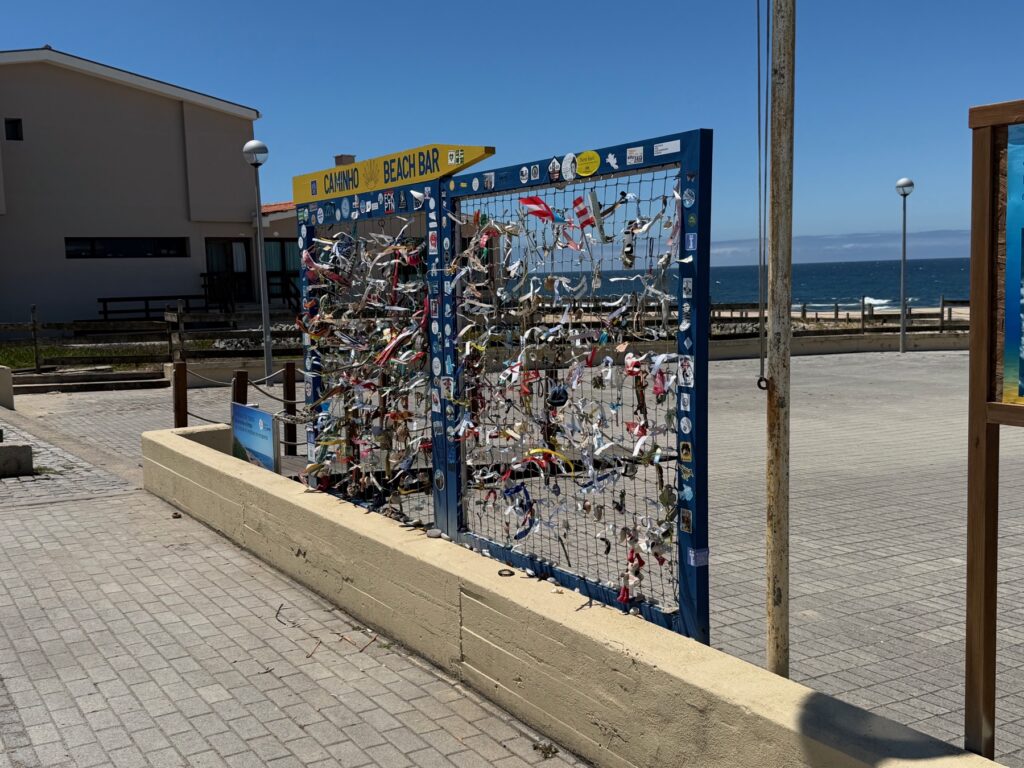
Just beyond the boats, at the Caminho Beach Bar, there is a wire frame that has been accumulating pilgrim offerings for years — shoelaces, flags, bandanas, folded notes, walking-stick tips. Every person who passes ties something on. It is not a monument, not organised, not particularly tidy. That is what makes it worth a moment of your time.
North to Esposende
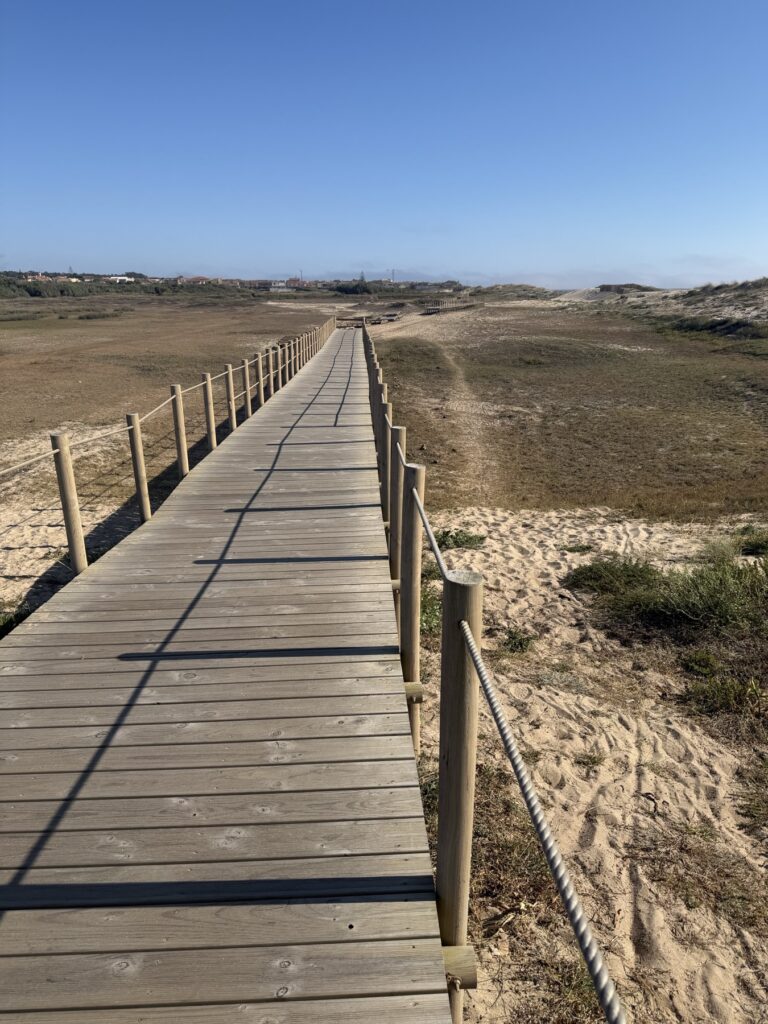
North of Apúlia, the route crosses a protected dune system. The wooden boardwalk through this stretch was closed when we passed — maintenance, or seasonal protection, the sign did not specify — so we took to the beach instead. This turned out to be no hardship: the sand here is firm and flat at the tideline, and the beach is wide enough that you walk with open ocean to your left and the dune ridge to your right, completely alone. The kind of walking that makes you wonder why you ever bother with paths.
The approach into Esposende follows the mouth of the Cávado river. The town appears gradually — first a fort on the far bank, then buildings, then the bridge. After five hours of coast and dunes, the sight of a real town is satisfying in the way that finish lines always are.
Arrival in Esposende
Esposende sits at the mouth of the Cávado river. It is a proper town with a history going back to the Romans — there was a settlement here long before pilgrims invented the route — and it has the quiet confidence of a place that does not need to advertise itself. The old fort still stands. The fishing boats still work. The cafés have the right balance of unhurried and functional.
In the main plaza you will find a piece of modern sculpture that has become something of a landmark: two large curved arcs of weathered corten steel forming a lens shape, enclosing a bronze figure. The rusted metal echoes the colour of the fishing boats. It is striking in the way that good public art is striking — it fits the place it is in without trying to explain itself.
Esposende is a comfortable place to finish a day. There are good options for accommodation along the main street and near the riverfront, restaurants worth sitting down at, and a quiet that the larger coastal cities do not have. After 25 kilometres on flat, open ground, quiet is exactly what you need.
What Day 2 tells you
The elevation profile for Day 2 is almost a flat line. There are no climbs, no descents worth mentioning — the route drops barely three metres over its entire length. What this stage is about is distance and exposure: 25 kilometres of open coastline, wind in your face, sun overhead, sand underfoot for long stretches. It is easy in the sense that it does not punish you with hills. It is long in the sense that flat kilometres still accumulate in the legs.
After Day 1’s brutal introduction, Day 2 is a recalibration. This is what the Coastal Camino is going to be: ocean, dunes, small towns, good light, and enough kilometres each day to make it feel earned when you stop.
Practical Info
- Start: Póvoa de Varzim seafront — the route picks up yellow arrows from the main promenade heading north
- End: Esposende town center, near the main plaza and Cávado riverfront
- Distance / Difficulty: 25.2 km — entirely flat, the easiest terrain of the coastal route; manageable for most fitness levels
- Food & water: Good availability throughout — Aguçadoura and Apúlia both have café stops, and Esposende has everything you need for the evening
- Dune boardwalk: The boardwalk through the protected dune reserve north of Apúlia is sometimes closed — the beach route alongside is perfectly walkable and arguably better
- Accommodation: Concentrated in Esposende; several hotels and one albergue near the riverfront — book ahead in summer months
- Best time to start: Morning out of Póvoa — the seafront mural and the chapel at Aguçadoura are both better in morning light, before the heat builds