
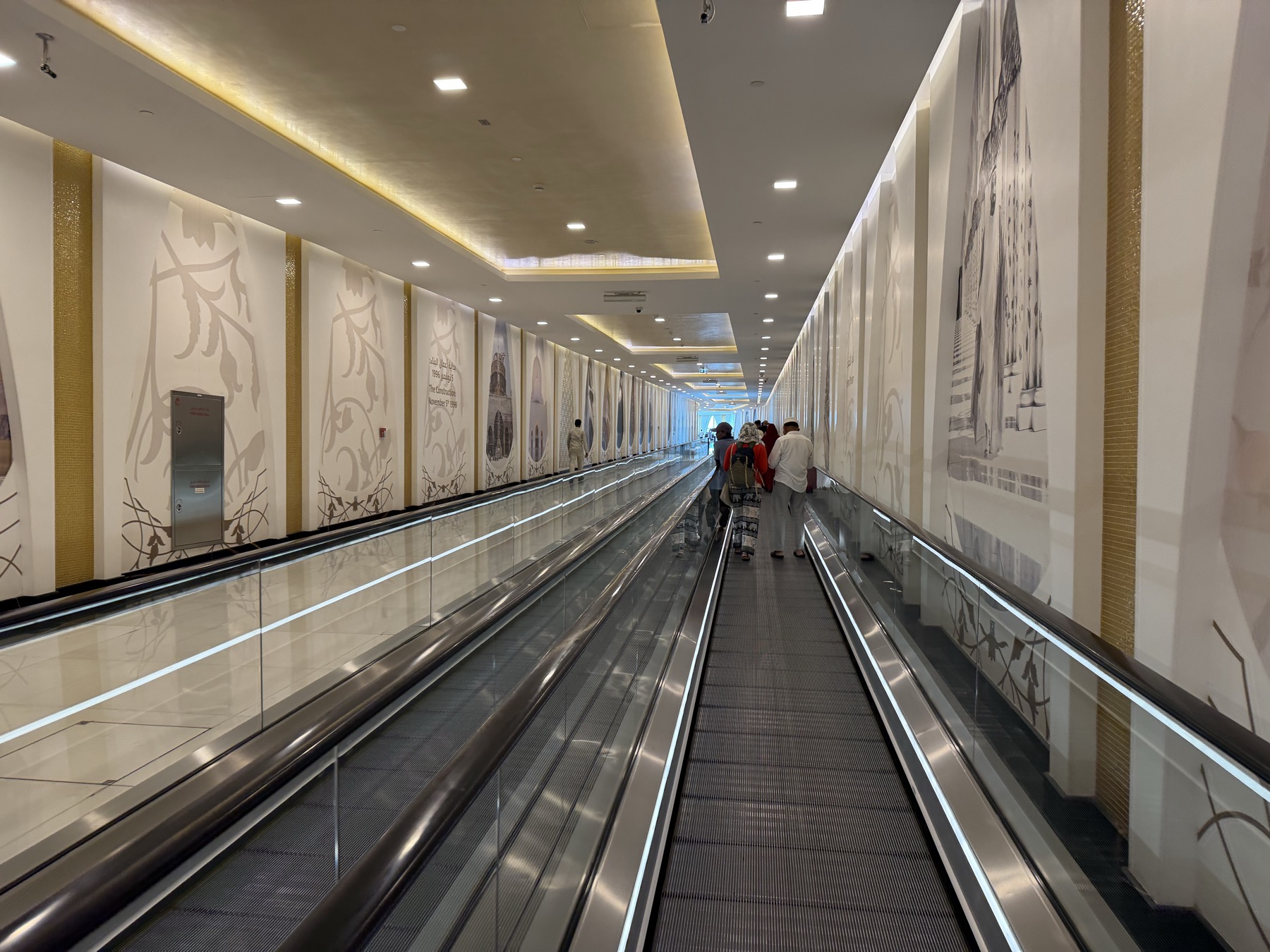
The doors open at nine. We were there at five past, walking through an underground corridor lined floor-to-ceiling with Arabic calligraphy murals while a travelator carried the first few visitors slowly toward the light at the far end. The Grand Mosque was not yet crowded. It would not stay that way for long — five million people visit each year — but for these first minutes it was as close to quiet as a building this size ever gets.
The Sheikh Zayed Grand Mosque was completed in 2007 after thirteen years of construction and stands as the largest mosque in the United Arab Emirates. It is named after Sheikh Zayed bin Sultan Al Nahyan, the founding father of the UAE, who is buried in a mausoleum adjacent to the main building. His vision for the mosque was specific: draw on the great Islamic architectural traditions of the world — Moorish, Ottoman, Mughal — and bring the finest craftsmen from every corner of it. More than 3,000 workers from 38 contracting companies, spanning Greece, Morocco, India, Germany, Italy, China, Turkey, the UK and elsewhere, spent over a decade making that happen.
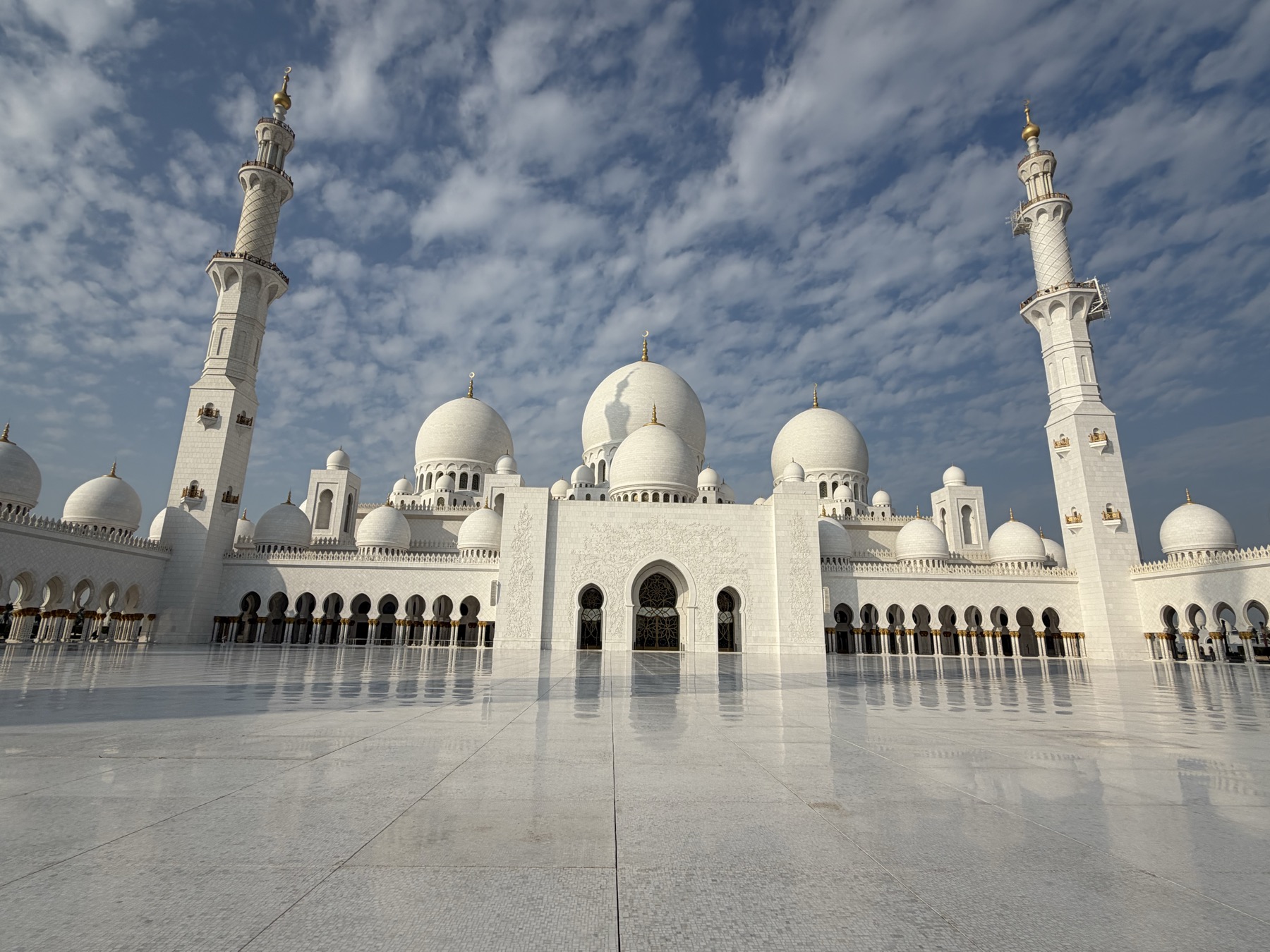
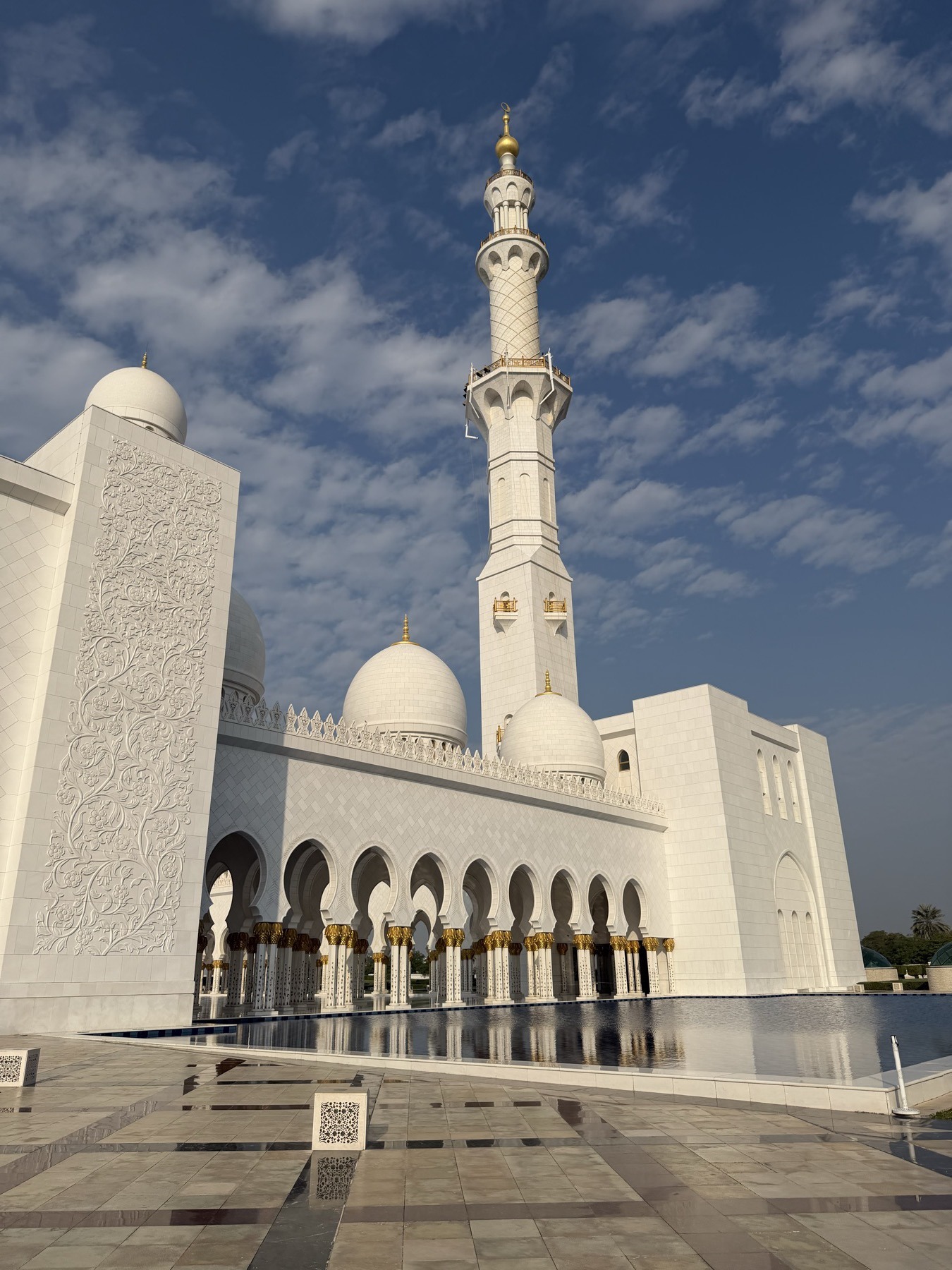
From the street the building registers as very white and very large. Up close, at the entrance on the south side, you begin to understand the scale: four minarets, each over 100 metres tall, anchor the corners of the complex. The approach is a long walkway of polished granite past a series of reflecting pools. When we arrived the pools were still calm, the white marble reflected perfectly in the water, and the light was the low-angle gold of December morning in the Gulf.
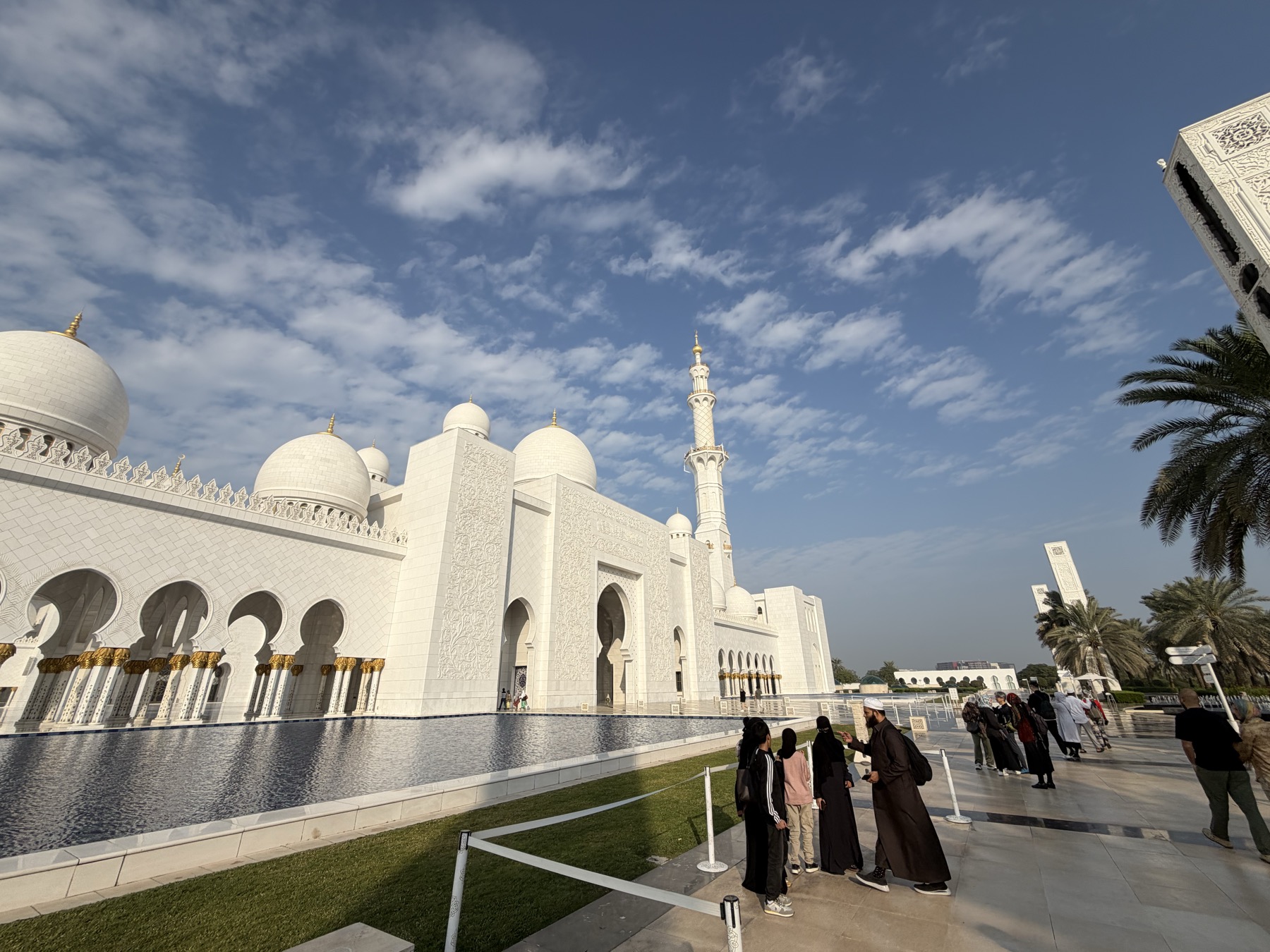
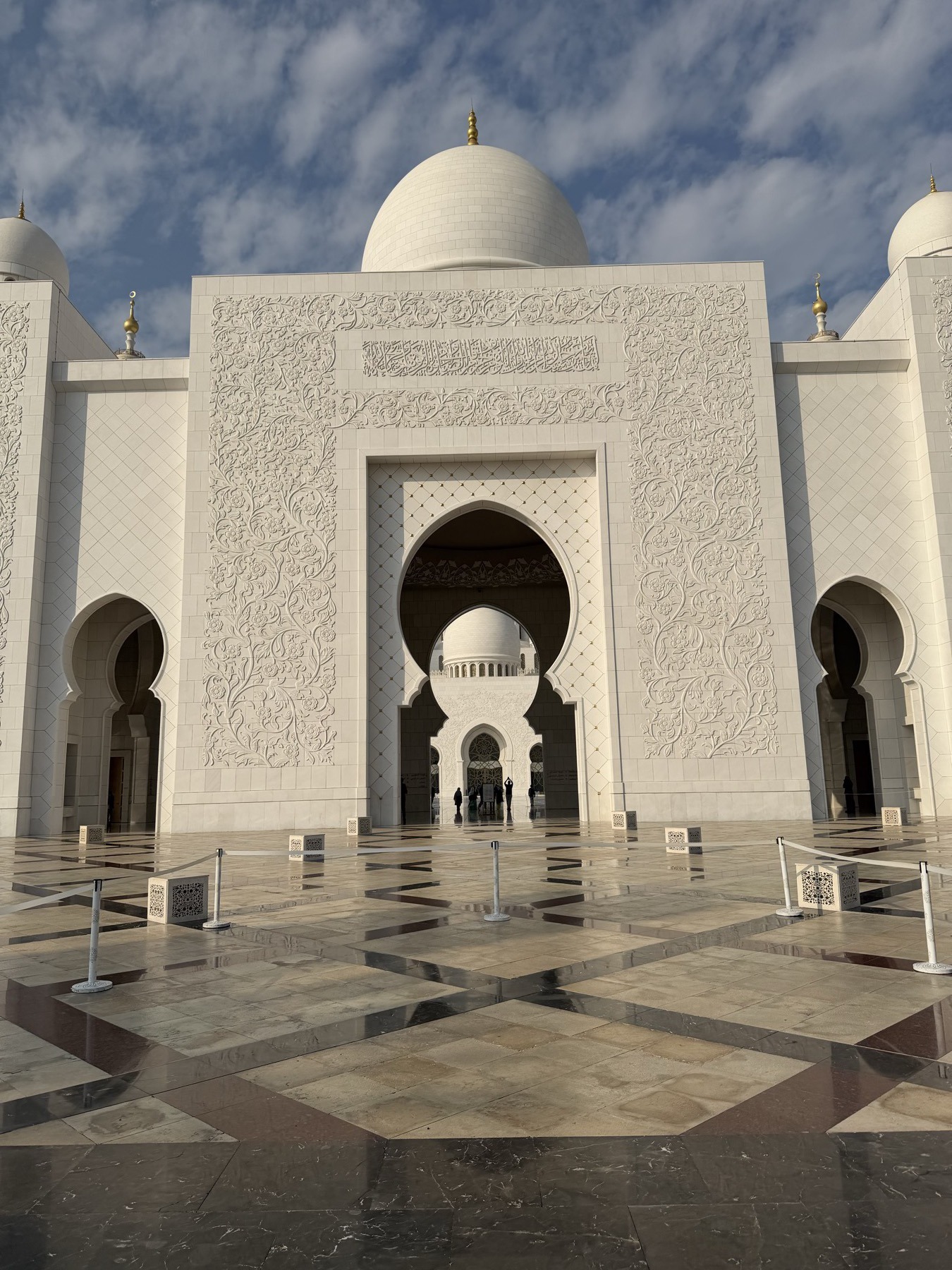
The main entrance arch is where the scale becomes genuinely difficult to process. The carved arabesque facade surrounding the arch is enormous — every centimetre of it hand-finished — and through the arch you can see another arch, and through that a dome, the mosque receding in layers of white marble and sky. We stood there for longer than we planned to.
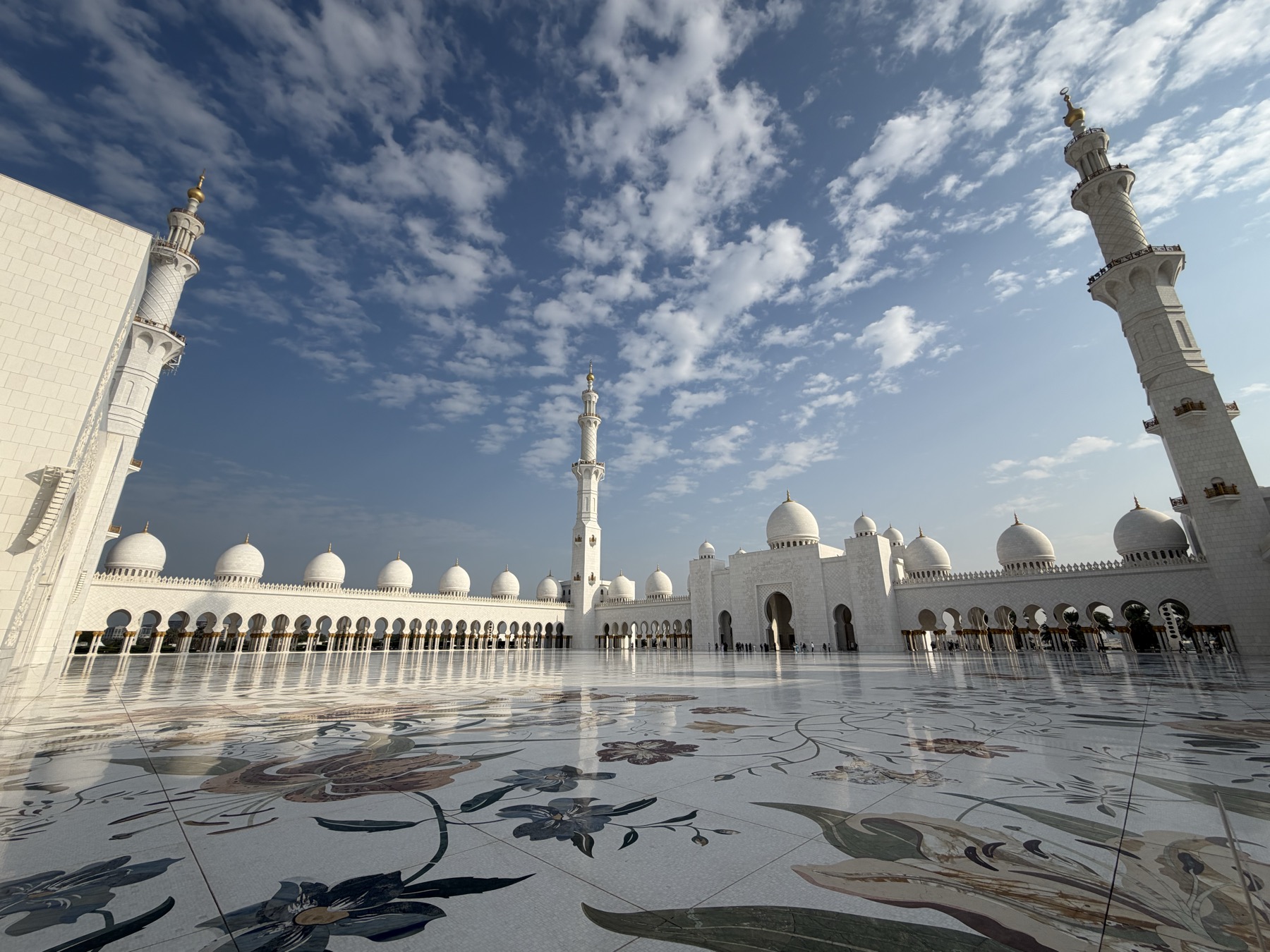
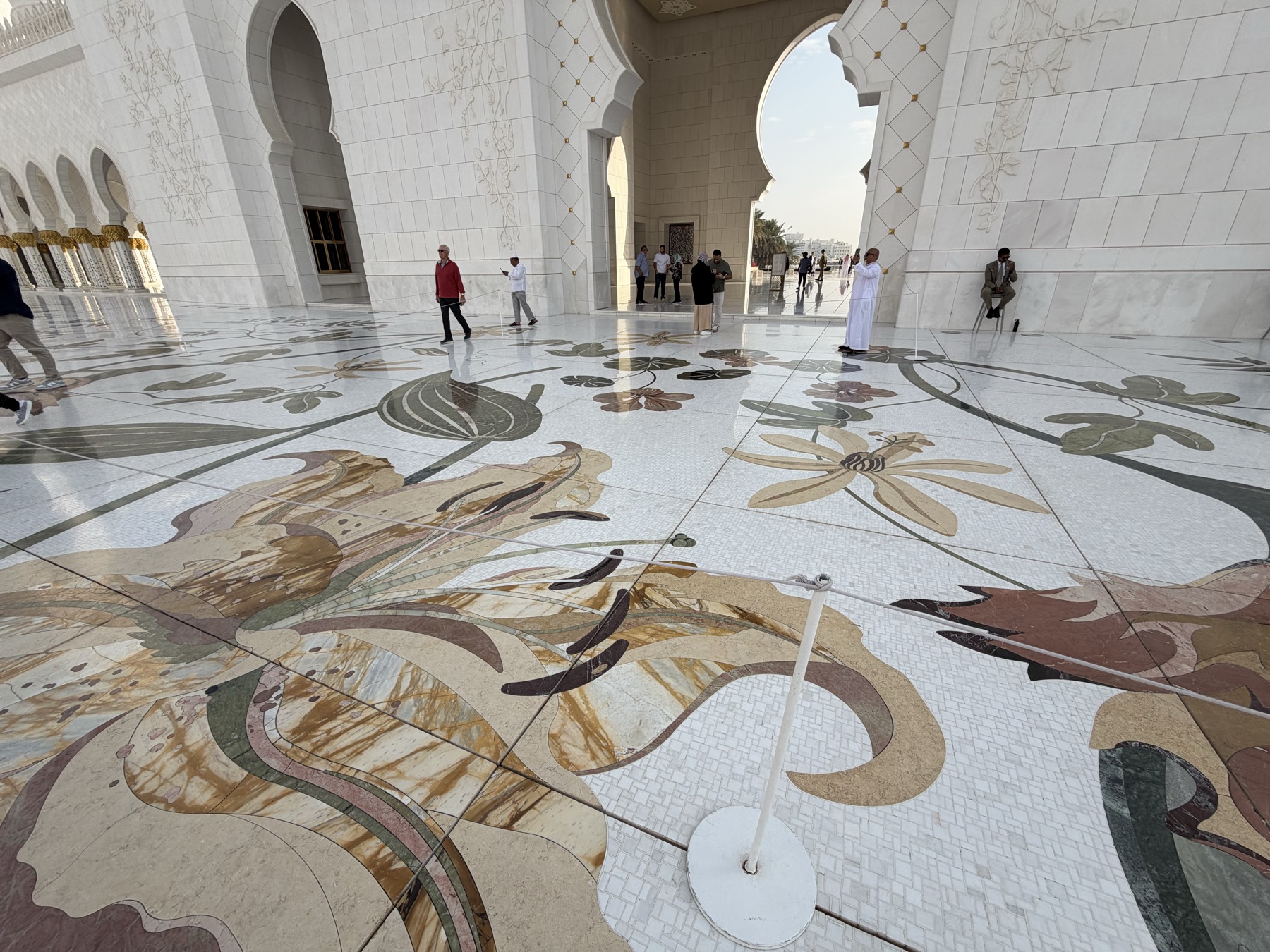
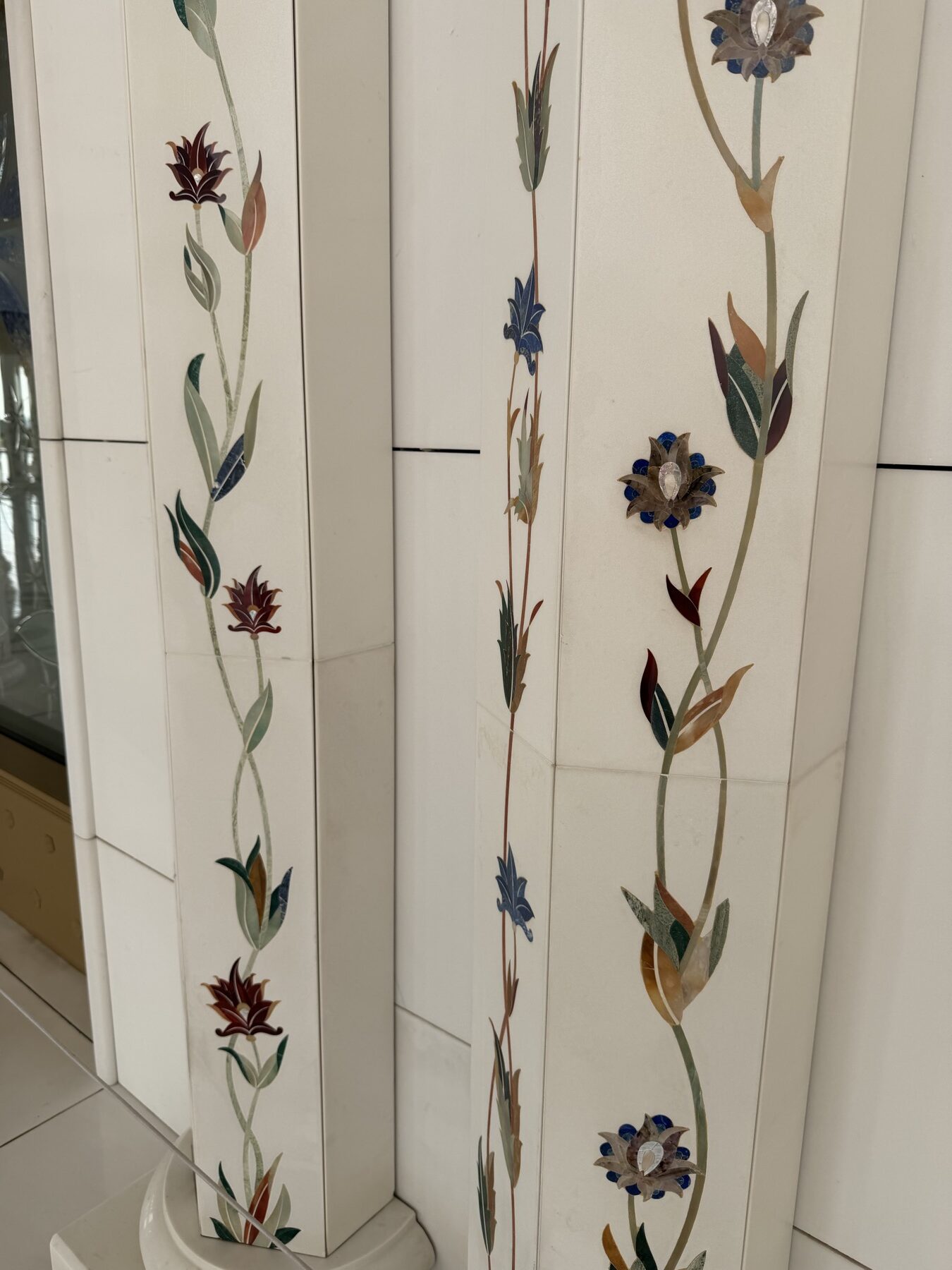
Once inside, the guided route takes you around the outer courtyard and then into the main prayer hall. The courtyard itself would be the centrepiece of almost any other building in the world — here it is the approach. The floor is white marble from Macedonia, inlaid with a botanical pattern of flowers and vines executed in dozens of varieties of coloured stone. Early in the morning, with the light coming in low from the east, the inlay casts faint shadows and the whole surface appears to move slightly.
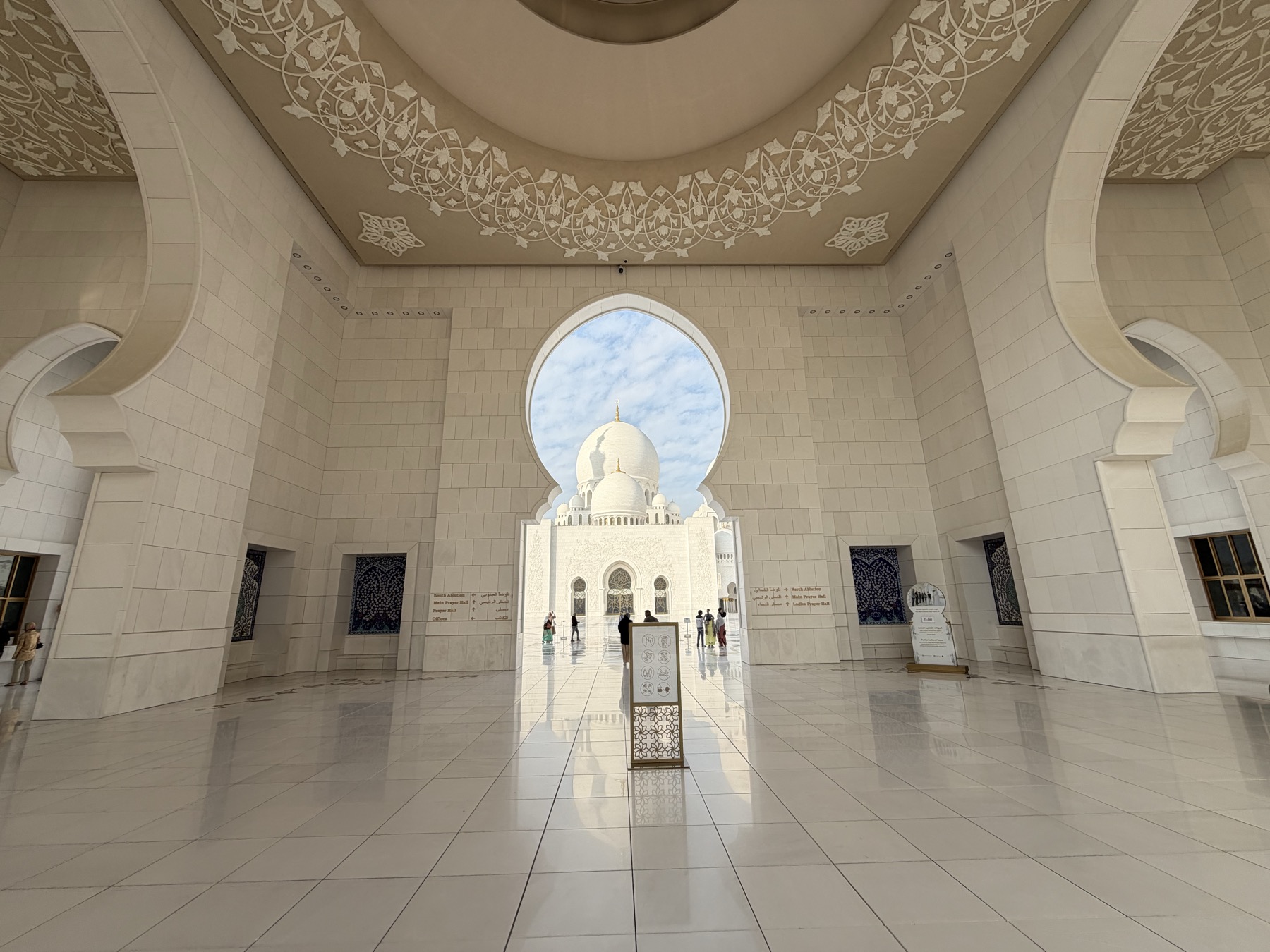
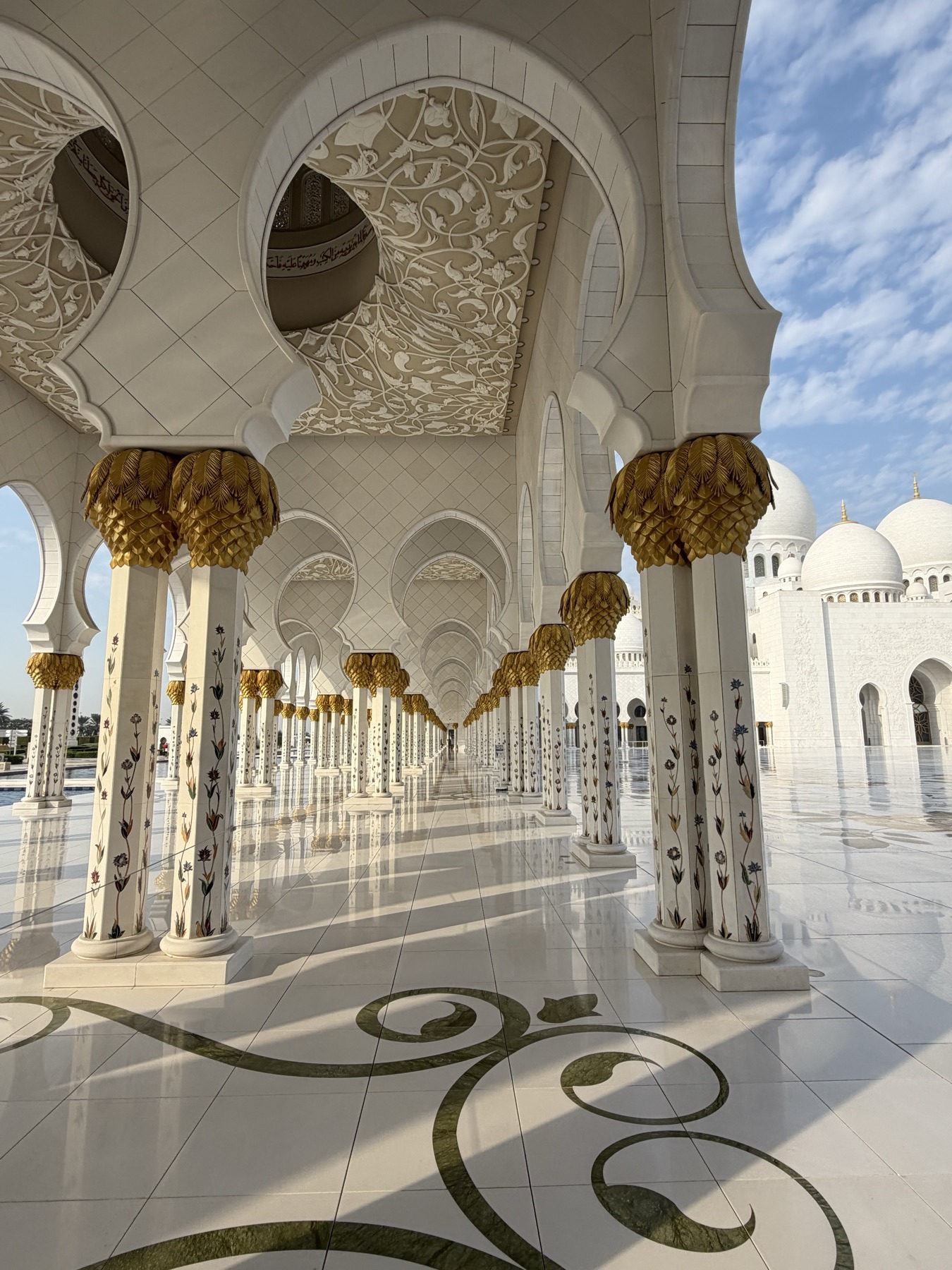
The colonnade running along the outer edge of the courtyard is one of the most photographed elements of the mosque, and deservedly. Over a thousand columns — each clad in white marble and inlaid with semi-precious stones in individual floral patterns — support a series of arches. At the capital of each column sits a gilded bronze pineapple finial, a detail that sounds peculiar until you see it repeated at scale along the full length of the arcade and realise it reads as something between opulence and natural geometry. The reflection of the columns in the polished stone floor doubles everything.
The main prayer hall is the interior. Entry requires removing your shoes, and for women the mosque provides free abayas at the entrance — long robes with a head covering — as part of the dress code. There is no pressure and no embarrassment in the process; staff at the entrance are matter-of-fact and genuinely welcoming, and the offering of the abaya feels like hospitality rather than restriction.
Inside, the scale recalibrates again. The hall is dominated by the world’s largest hand-knotted carpet, which covers 5,627 square metres of floor. It took 1,200 Iranian artisans two years to complete, contains over two billion individual knots, and weighs 35 tonnes. The design is a garden of stylised flowers and vines, in deep greens and reds and golds. Looking at it from the edge and trying to understand that every square centimetre was tied by hand is the kind of thought that takes a while to settle.
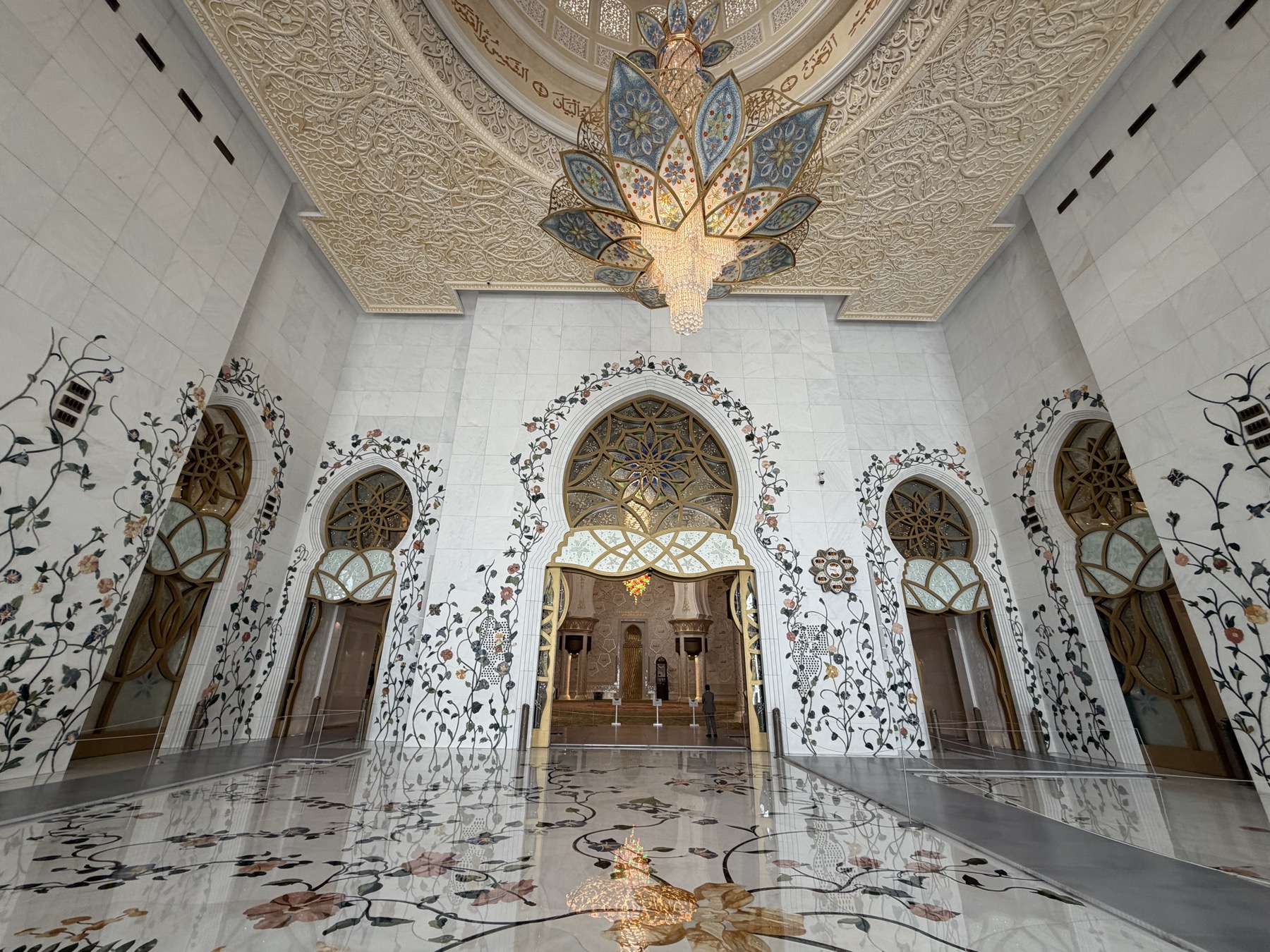
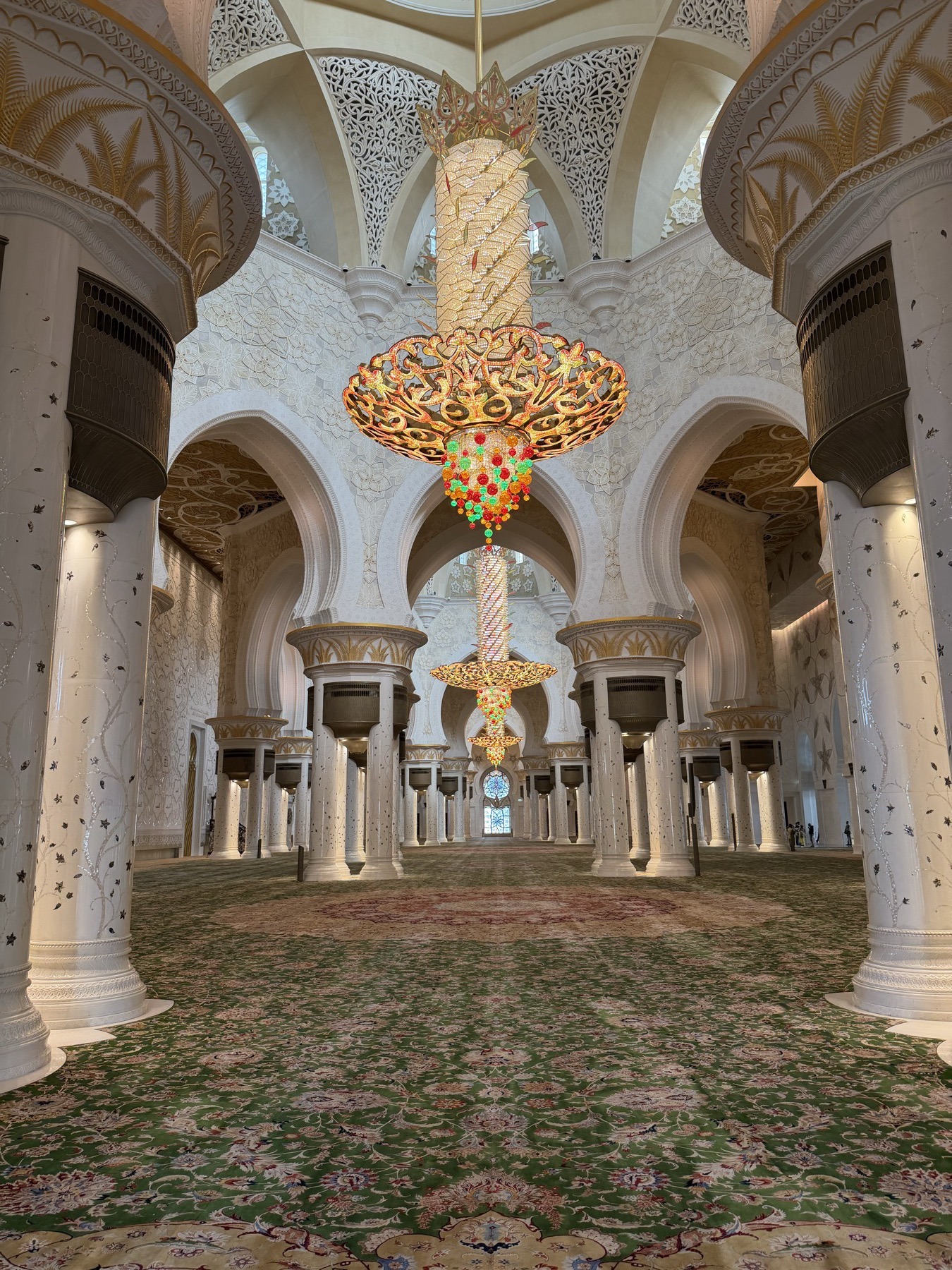
Above the carpet hang seven chandeliers. The largest is ten metres in diameter, weighs twelve tonnes, and is set with millions of Swarovski crystals and semi-precious stones. The light it throws is warm and diffuse, and in the silence of the early morning — the call to prayer long finished, the crowds not yet arrived — the hall was genuinely still.
The craftwork visible on every surface is the other thing worth spending time with. The columns in the prayer hall are inlaid with mother-of-pearl floral patterns, each one different. The marble walls throughout the complex are set with botanical friezes of lapis lazuli, malachite, jasper and carnelian, the stones cut and fitted with a precision that makes the joins nearly invisible.
What is harder to write about is the atmosphere. The Grand Mosque is a working house of worship, not a museum, and it is managed as one — respectfully, with some seriousness about what the space is for. Non-Muslim visitors are welcomed without reservation, but the building does not perform itself for tourists. It is simply what it is: an extraordinary act of collective craft and intention, open to whoever wants to come.
We followed the guided route for about two hours, which is enough to cover the main areas without rushing. The mosque does not require you to know anything about Islamic architecture or history to find it moving — though if you arrive knowing a little, you will find you keep noticing things. We left just as the first tour groups of the morning were arriving. The reflecting pools were beginning to catch the stronger mid-morning light. The white marble, which at opening had glowed a soft amber, was now a brilliant, almost physical white.
Practical notes
- Entry is free for all visitors, regardless of religion or nationality.
- Dress code: full sleeve coverage and long trousers for all. Women must also cover their hair; free abayas are provided at the entrance.
- Hours: open Saturday–Thursday 9am–10pm. Closed to non-worshippers Friday morning (reopens 2pm).
- Getting there: the mosque is in Abu Dhabi, approximately 90 minutes from central Dubai by car. Taxis are straightforward; there is also a public bus from Abu Dhabi city centre.
- Photography is permitted throughout, including inside the prayer hall when not in use for worship.
- Arrive early. The difference between 9am and 10:30am in terms of crowd density is significant.